News
Subscribe

Announcement
Stellar Alpina completed Europe’s first commercial RDRE hotfire and raises $4.5m within 82 days
Stellar Alpina has completed Europe’s first commercial rotating detonation rocket engine hotfire and raised USD 4.5 million in pre-seed funding within 82 days of incorporation.
The round was led by Founderful, with participation from LP&E and strategic investors backing the next generation of space infrastructure. For Stellar Alpina, the timing matters as much as the number: from incorporation to tested hardware in less than three months.
From incorporation to ignition
Stellar Alpina was founded to build a new class of in-space propulsion from Switzerland. Within 82 days, the team built the test infrastructure, prepared the first engine campaign, and completed a successful hotfire of a rotating detonation rocket engine.
That sequence reflects the operating culture behind the company: move fast enough to learn, build physical proof early, and keep the distance between ambition and hardware as short as possible.
The company’s first milestone is not a slide deck, a simulation, or a future promise. It is tested hardware.
The bottleneck after launch
Launch is becoming cheaper and more frequent. More satellites, vehicles, and infrastructure can now reach orbit than ever before. But once assets are in space, moving them to where they actually need to operate remains a major constraint.
Today, much of that mobility still depends on propulsion architectures that have changed only incrementally over decades. For orbital logistics, high-energy transfers, and future lunar infrastructure, that creates a bottleneck.
Stellar Alpina is building for that layer: the space between launch and destination.
Why rotating detonation propulsion
Rotating detonation rocket engines use controlled detonations to generate thrust. The architecture has the potential to offer higher performance, fewer mechanical components, and substantially reduced system volume compared with conventional approaches.
For in-space mobility, those advantages matter. Every kilogram, every cubic centimetre, and every moving part affects what missions can do, how fast they can iterate, and how far they can go.
Stellar Alpina is developing detonation-based propulsion as the foundation for a broader architecture: high-performance engines, modular in-space vehicles, and eventually lunar delivery systems.
Building from Switzerland
The hotfire and funding round mark an early step toward a larger ambition: proving that serious upstream space hardware can be built from Zurich.
Switzerland brings a rare combination of precision engineering, industrial trust, research excellence, manufacturing depth, and long-term institutional stability. Stellar Alpina exists to translate that foundation into flight-capable systems.
The company is still at the beginning. But the signal is clear: Switzerland is no longer only contributing components, research, or services to the global space economy.
It is building the hardware that moves missions forward.
Onwards
The pre-seed round gives Stellar Alpina the resources to continue development, expand its team, deepen its test capability, and move from first proof toward a new mobility layer for space.
The mission ahead remains difficult. But the first answer has already been given in metal, pressure, flame, and data.
82 days from incorporation to engine hotfire.
Now the work continues.

Article
Inside the Stellar Alpina Reveal Event
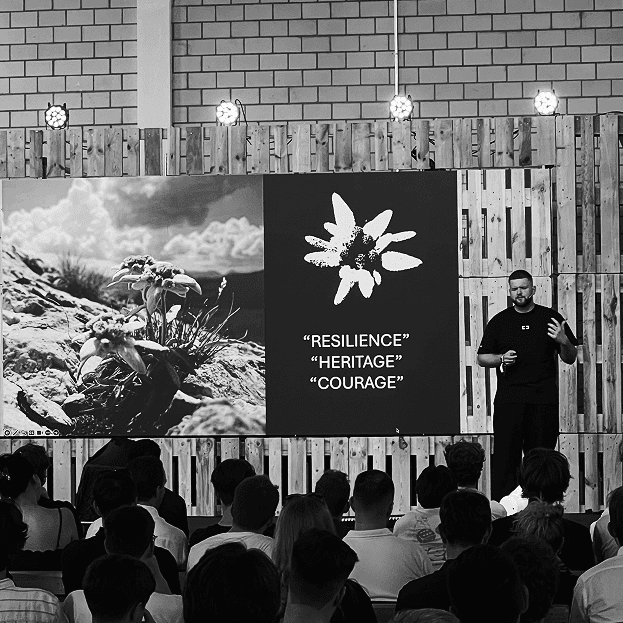
On 29 May 2026, Stellar Alpina opened its doors at Switzerland Innovation Park Zurich.
The goal was simple: share the founding story, reveal the company’s first engine, and bring together the people shaping the next chapter of space in Switzerland and Europe.
More than 230 guests joined the evening. Founders, engineers, investors, students, industrial partners, public figures, friends, and members of the wider space ecosystem gathered around one thing: hardware that had moved from ambition into reality.
More than a company reveal
Some startups begin with a slide deck. Stellar Alpina began with a hotfire.
The Reveal Event was designed around that difference. It was not only a brand launch, a networking evening, or a formal announcement. It was a moment to show the work behind the company: the engine, the test campaign, the founding team, and the ecosystem forming around them.
Stellar Alpina was founded in February 2026 by ARIS alumni who had already spent years building, testing, failing, and learning through student rocketry. By the time the company opened its doors, it had already completed its first successful hotfire campaign with Engine 0, a rotating detonation rocket engine.
That made the evening feel different. The vision was not abstract. It had physical weight.
Hardware in the room
At the centre of the event was the first engine.
For Stellar Alpina, revealing hardware matters because it changes the conversation. Space companies can often sound distant, speculative, or years away from reality. A tested engine does the opposite. It makes the work tangible.
Guests could see the direction of the company: detonation-based propulsion for the next era of in-space mobility. Not only a single component, but the first step toward a broader architecture of engines, vehicles, and lunar delivery systems.
The reveal showed that serious upstream space hardware is being built in Zurich — not as a metaphor, but as metal, infrastructure, testing, data, and iteration.
Building Switzerland’s place in space
The evening also featured a panel on Switzerland’s role in the future of space with Thomas Süssli, Stefan Brupbacher, and Florian Kehl.
Together, the discussion moved beyond the company itself. It asked a larger question: how can Switzerland turn research excellence, industrial strength, and entrepreneurial speed into real space capability?
The answer will require more than ambition alone. It will require industrial depth, advanced manufacturing, testing infrastructure, patient capital, institutional awareness, and ecosystems where these elements can meet.
That is what made the setting meaningful. Switzerland Innovation Park Zurich is not only where Stellar Alpina is based. It is part of the environment that makes this kind of company possible.
From ARIS to upstream space hardware
Stellar Alpina’s story is closely connected to ARIS, the Academic Spaceflight Initiative Switzerland. ARIS gave the founders a place to build serious hardware before founding a company. It gave them responsibility early, exposed them to pressure, and created the shared engineering culture that now carries into Stellar Alpina.
The Reveal Event made that transition visible.
What began as student rocketry has become a commercial space venture focused on high-performance propulsion and in-space mobility. The same mindset remains: build, test, learn, and keep moving.
A new chapter
The evening marked a beginning, not a finish line.
The hotfire campaign, the engine reveal, and the pre-seed round gave Stellar Alpina early momentum. But the company’s larger ambition remains ahead: to build a new class of propulsion and mobility infrastructure from Europe, with Switzerland as a serious base for upstream space hardware.
A huge thank you to everyone who joined, supported, challenged, photographed, invested, advised, and believed in what is being built.
This was not just an event.
It was the beginning of a new chapter.
Onwards.

Report
Stellar Alpina joins the Swiss Deep Tech Report 2026 Watchlist
Stellar Alpina has been included as a Watchlist Company in the Swiss Deep Tech Report 2026 in the Aerial & Space category.
Founded in February. Featured in June.
For a company still at the beginning of its journey, the recognition is an early signal: Switzerland’s next generation of space companies is no longer theoretical. It is being built through hardware, infrastructure, talent, and tested ambition.
A signal from the Swiss deep-tech ecosystem
The Swiss Deep Tech Report maps the companies and sectors where Switzerland is developing structural strength. For Stellar Alpina, being included in the Watchlist matters because it places the company inside a broader national movement: deep-tech founders turning research density, industrial capability, and long-term engineering culture into globally relevant companies.
The report also names Stellar Alpina in the context of Switzerland’s space economy and the new generation of companies emerging where world-class research meets global ambition.
That is exactly the intersection Stellar Alpina is building from.
Why Aerial & Space matters
Space is not only a scientific domain. It is becoming an infrastructure layer for communications, security, navigation, climate monitoring, logistics, and future industrial activity beyond Earth.
For Europe, the strategic question is no longer only access to launch. It is what happens after assets reach orbit: how they move, reposition, transfer, and eventually support missions beyond low Earth orbit.
That is the area Stellar Alpina is focused on.
By developing rotating detonation propulsion, modular in-space vehicles, and lunar delivery systems, the company is working on the mobility layer that future missions will depend on.
Switzerland’s advantage
Switzerland has a rare combination of strengths for deep tech: research excellence, precision manufacturing, trusted institutions, capital, supplier depth, and a culture of high-quality execution.
In Aerial & Space, those strengths can become especially relevant. Space hardware rewards reliability, technical discipline, and the ability to turn complex engineering into repeatable systems.
The Swiss ecosystem is also moving fast. According to the report, the Swiss Aerial & Space ecosystem includes more than 40 VC-backed startups, with USD 791 million raised since 2020 and a combined enterprise value of USD 2.7 billion.
Stellar Alpina’s inclusion reflects that momentum.
From recognition to responsibility
Being named to a watchlist is not the goal.
For Stellar Alpina, it is a responsibility to keep building. The company’s early work is focused on controlled detonations, tested propulsion, and the larger infrastructure required for in-space mobility.
The mission is clear: turn frontier engineering into space mobility infrastructure, built from Switzerland.
That means continuing to test, hire, partner, and move from early proof toward systems that can support orbital logistics, high-energy transfers, and future lunar missions.
Building from Switzerland
The inclusion in the Swiss Deep Tech Report reinforces a larger idea: Switzerland can play a more active role in upstream space hardware.
Not only as a research contributor. Not only as a supplier. Not only as a location for precise components.
But as a place where new space companies are founded, funded, and built.
Stellar Alpina is proud to be part of that emerging ecosystem.
The work continues.

Article
Why Stellar Alpina
Names matter.
Stellar Alpina was built around a simple belief: Europe needs companies that can build serious space hardware, not only software, services, or isolated components. From Zurich, the company is developing high-performance propulsion, modular in-space vehicles, and the delivery systems required to move payloads beyond orbit and eventually to the lunar surface.
The name carries that ambition.
Stellar
“Stellar” stands for something that goes above and beyond. It reflects excellence, ambition, and the decision to build toward a standard that is larger than the immediate milestone.
For Stellar Alpina, that means not stopping at a single engine campaign or one isolated propulsion demonstrator. The company is building toward an integrated architecture for in-space mobility: engines, vehicles, and delivery platforms that can serve the next phase of the space economy.
Alpina
“Stella Alpina” is the Italian name for the edelweiss.
The edelweiss grows in harsh alpine conditions. It is resilient, recognisable, and deeply connected to the geography Stellar Alpina comes from. That made it the right symbol for the kind of company the founders wanted to build: Swiss-rooted, technically ambitious, and capable of operating in demanding environments.
The Alpine reference is not nostalgia. It is a statement of origin.
Stellar Alpina is built in Switzerland, but not for Switzerland alone.
Swiss roots, global ambition
Switzerland has long played a role in Europe’s space story as a founding member of ESA and as a home for precision engineering, advanced manufacturing, research, and trusted institutions.
Those strengths matter in space. Hardware systems require more than invention. They require repeatability, supplier depth, quality culture, and the ability to translate research into reliable industrial execution.
Stellar Alpina is building from that foundation.
The company’s ambition is global: to develop propulsion and mobility systems that can support orbital logistics, high-energy transfers, and eventually lunar delivery. But the operating logic is distinctly Swiss: precision, resilience, trust, and long-term engineering discipline.
Why Zurich
Zurich adds another layer.
Within a small radius, the region brings together ETH Zurich, technical talent, industrial partners, investors, startup infrastructure, additive manufacturing, robotics, and a growing space ecosystem. Few places offer that density.
For a deep-tech company, proximity is infrastructure. It changes the speed at which a team can move from research to supplier conversation, from prototype to test setup, from investor meeting to industrial partnership.
Stellar Alpina’s home at Switzerland Innovation Park Zurich reflects that logic. The site connects space, additive manufacturing, and robotics — the same domains that define the company’s work.
The address is not only symbolic. It is operational.
Why now
Europe’s space economy is changing. Launch is becoming more accessible, space infrastructure is becoming more distributed, and governments and companies are paying closer attention to sovereignty, mobility, and resilience in orbit.
The question is no longer only how to reach space. It is how to operate there, move there, and build capability beyond the first launch.
That is the layer Stellar Alpina is focused on.
The company we are building
Stellar Alpina is not built around a single founder, a single test, or a single announcement. It is built around a system: shared leadership, early hardware proof, strong technical roots, and an ambition that extends from propulsion to lunar delivery.
The next generation of space companies will not only come from traditional aerospace capitals. They will also come from places that combine technical excellence, manufacturing depth, long-term trust, and the courage to build difficult things.
That is why Stellar Alpina is being built in Zurich.
Swiss roots. Global ambition. Built for space.

Company
Four Founders, No Throne
Space hardware does not reward hero culture.
The systems are too complex, the margins are too thin, and the consequences of weak decisions are too real. Engines, vehicles, avionics, structures, test infrastructure, suppliers, procedures, financing, and mission architecture all have to move together.
That is why Stellar Alpina was not built around a single throne.
It was founded by four co-founders with shared roots, complementary strengths, and one operating belief: the company must be accountable as a system.
Shared DNA
The founders of Stellar Alpina all grew out of the same ecosystem: ARIS, the Academic Spaceflight Initiative Switzerland.
ARIS was where student rocketry became serious engineering. It was where ambitious ideas met real constraints: cold test sites, long nights, uncertain budgets, pressure before ignition, and the hard discipline of making hardware work outside the comfort of theory.
That experience shaped the company’s DNA.
Stellar Alpina is the continuation of that culture: student pioneers becoming moonshot engineers, carrying the same build-test-learn mindset into commercial space hardware.
Simi Wespi: propulsion obsession
Simi Wespi’s path has been defined by rocket propulsion.
At ARIS, he led Project Perseus, where a small team built and fired a rotating detonation rocket engine in under six months. The project made Switzerland the seventh nation ever to hotfire such an engine and showed what focused young engineers could achieve with limited resources and high conviction.
At Stellar Alpina, Simi carries that propulsion vision forward: turning RDREs from experimental demonstrations into practical engines for satellites, transfer vehicles, and future lunar infrastructure.
Rick Röthlisberger: systems under pressure
Rick Röthlisberger brings the systems perspective.
Before Stellar Alpina, he worked at Rocket Factory Augsburg as Main System Architecture Responsible and Deputy Head of Systems Engineering. He contributed to failure investigation, system architecture, and launcher development in an environment where decisions had direct hardware consequences.
At ARIS, he was already deep in competition rocketry and systems engineering. That background gives him a holistic view of how vehicle, propulsion, avionics, ground systems, operations, and architecture need to fit together.
At Stellar Alpina, Rick helps make sure the company does not only build impressive components, but coherent systems.
Patrick Egli: from CAD model to ignition
Patrick Egli is the bridge between design and test.
During his time with Project Hephaestus at ARIS, his work spanned the development cycle from detailed engine components to hot-fire operations on the test stand. That experience matters because hardware is never only about design intent. It is about whether the part can be manufactured, assembled, checked, connected, fired, and trusted.
At Stellar Alpina, Patrick helps turn engineering ambition into hardware that is ready for test. Engines may get the spotlight, but reliable ignition depends on the procedures, infrastructure, and discipline around them.
Victor Elliesen: ecosystem, direction, and execution
Victor Elliesen’s route into space was not the classical aerospace path.
He began with a commercial apprenticeship in Obwalden before finding his direction through ARIS and the engineering-facing work around ambitious space projects. That path shaped a founder who understands both the technical culture and the ecosystem required to make deep-tech companies real.
At Stellar Alpina, Victor helps connect ambition, business execution, partnerships, and the belief that Zurich can become a hub for world-class space hardware.
No throne
The shared leadership model is not a branding gesture. It is a practical decision.
Space hardware requires disagreement without ego, speed without recklessness, and accountability without theatre. It requires founders who can stress-test ideas, discard them, rebuild them, and still move in the same direction.
That is the meaning of “Four Founders, No Throne.”
No single hero. No founder mythology. No dependency on one voice.
Instead: four founders, shared responsibility, and one trajectory.
From test stand to the Moon
Stellar Alpina is building high-performance propulsion, modular in-space vehicles, and lunar delivery systems from Switzerland.
That mission will require capital, industrial partners, test infrastructure, talent, and time. But it also requires the right founding culture: one that can handle pressure, make decisions, and keep building when the work becomes difficult.
The company began with four founders who had already learned that lesson in the field, on test stands, in failure reviews, and through years of student rocketry.
Now the same DNA is being applied to a larger ambition.
From ARIS to Zurich.
From student pioneers to commercial space hardware.
From test stand to the Moon.